Passwords to a 17-Year-Old: The Fortnight a Cardiff Florist Handed Her Instagram to the Teenager
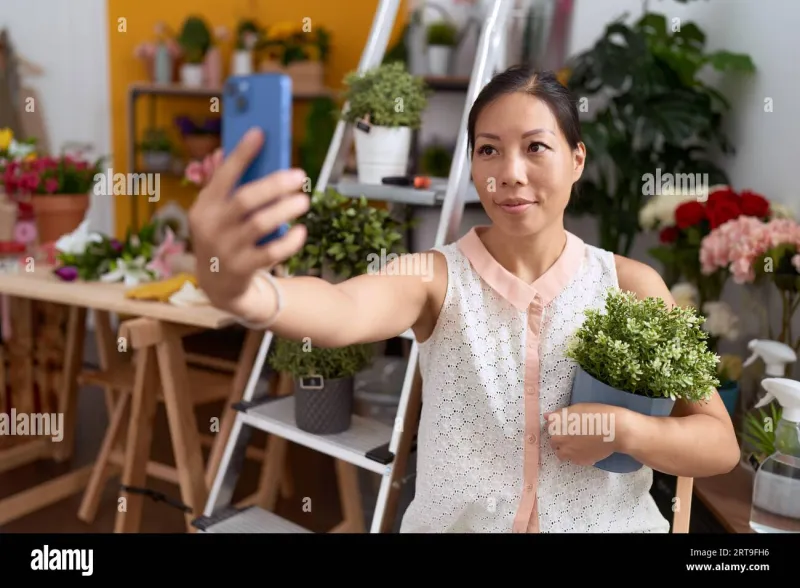
Photo: teenager filming smartphone flower shop small business, via c8.alamy.com
There's a moment every small business owner dreads. It's not the tax return or the awkward customer complaint. It's the moment your teenage nephew looks at your Instagram grid, screws up his face, and says: 'Why does it look like this?'
That's roughly how it started for Rhian Morgan, who runs a florist shop just off Cowbridge Road in Cardiff. Her nephew Ieuan, seventeen, home for the summer and surgically attached to his phone, made the observation over a family roast. Rhian's response was the sort of thing many of us have muttered: 'Fine, you do it then.'
He did. For a fortnight. And we followed along, because what happened next says a lot about the generational gap in British small business marketing — and what's actually worth stealing from it.
Week One: The Cringe Phase
The first three days were, by Rhian's own admission, 'touch and go'.
Ieuan's opening move was a TikTok of him arranging a bouquet to an audio trending that week, complete with a caption in lowercase and no full stops. Rhian hated it. The shop's regulars — a loyal bunch, mostly over fifty — said nothing, which somehow felt worse.
But the numbers told a different story. That single video outperformed anything the account had posted in six months. Not because it was clever marketing, but because it didn't look like marketing at all. It looked like a teenager mucking about in a flower shop, which is precisely what it was.
By day five, Ieuan had done things Rhian would never have sanctioned: filmed a customer's reaction to her wedding flowers (with permission, thankfully), replied to a comment with a voice note, and posted a Story of a rejected bouquet design with the caption 'she said this was too chaotic. was she right??'
That last one got forty-odd replies. The shop had never had a conversation like that on Instagram before.
Week Two: The Rules Start Creeping Back
Here's where it gets interesting — and where most takeover experiments quietly fall apart.
Halfway through week two, Rhian started getting nervous. The grid was a mess. There was a video of her laughing with her mouth open, which she described as 'deeply undignified'. She asked Ieuan to take down the voice note reply. He pushed back, and they compromised: content stayed up, but he ran draft captions past her before posting.
Engagement dipped slightly that week. Not dramatically, but noticeably. The unfiltered chaos was the thing people were responding to, and once it got filtered through a business owner's instinct to look professional, some of the magic leaked out.
This is the pattern we see again and again with these handovers. The younger person brings the fluency; the owner brings the caution; the middle ground ends up being worse than either extreme. The businesses that get real value from it are the ones where the owner resists the urge to sanitisise.
What Actually Worked
Strip away the novelty and three things Ieuan did are genuinely transferable, regardless of who's holding the phone.
He replied to everything, fast. Comments, DMs, the lot — usually within an hour. Rhian had been treating her inbox like email, checking it twice a week. Two people who'd enquired about funeral flowers in June finally booked, purely because someone answered their message the same day.
He showed the process, not the product. Rhian posted finished bouquets. Ieuan posted the three-hour Saturday morning rush, the deliveries stacked in the van, the bin full of trimmed stems. Nobody's asking a florist to become a content creator — but people buy from shops that feel alive.
He wasn't embarrassed. This is the hardest one to fake. Ieuan had no ego invested in the brand, so he posted things Rhian would agonise over for an hour. That lack of self-consciousness is the actual competitive advantage of youth here, not any innate understanding of 'the algorithm'.
What Rhian Kept
The fortnight ended, Ieuan went back to sixth form, and Rhian took the account back — but not entirely to how it was.
She still posts the finished bouquets she's proud of. But there's now a weekly 'the Saturday chaos' Story, she answers every DM within a day, and once a month she hands the phone to whoever's in the shop that afternoon — a teenager, a Saturday girl, whoever — with one instruction: just show what's actually happening.
Her follower count barely moved across the fortnight. Her enquiries, though, were up around a third compared to the previous month, and she puts it down to one thing: 'People stopped feeling like they were messaging a shop and started feeling like they were messaging a person.'
You don't need to hand your passwords to a teenager to learn that. But it doesn't half speed the lesson up.